
When consumers receive a scented candle, what they see is its beautiful appearance, their favorite fragrance, and the ambiance it creates when lit.
Yet, a scented candle that appears simple actually requires rigorous control across multiple stages before it reaches the consumer's hands.
From wax materials, fragrances, and wicks to formulation, pouring, cooling, packaging, and final burn testing—every step can influence product performance.
For brands, in particular, making a scented candle is not as simple as merely "adding fragrance to wax and pouring it into a jar."
A truly high-quality, consistent scented candle requires balancing fragrance, appearance, burning characteristics, and batch-to-batch uniformity.
This is why, when seeking the best scented candle factory in Guangzhou, China, brands should look beyond product photos and price quotes to understand the factory's underlying quality control processes.
I. Step One: Raw materials determine the product's foundation
Wax is one of the most critical raw materials in a scented candle.
Different wax materials affect the candle's hardness, appearance, melting rate, and burning performance.
If a brand wishes to develop a plant-based wax product, it must also consider the compatibility between specific plant wax systems and the fragrance oils.
Fragrance oils are just as important as the wax itself.
The same fragrance can perform differently—both in terms of "cold throw" (scent when unlit) and "hot throw" (scent when burning)—depending on the wax base used.
Therefore, before mass production begins, the factory must verify and match the raw materials rather than simply producing based on a fixed ratio.
Stable raw materials form the foundation for consistent quality later on.
II. Step Two: Matching the fragrance and wax through formulation
Many people believe that the most important aspect of a scented candle is the scent itself, but a stronger fragrance does not necessarily mean a better product.
An incorrect fragrance-to-wax ratio can compromise the integrity of the wax or negatively affect how the fragrance is released during burning.
Consequently, R&D specialists must adjust the formulation based on the characteristics of the wax and fragrance, as well as the product's intended positioning.
For instance, a brand might want the product to deliver a fresh, natural scent, a powerful room-filling aroma, a soft and sophisticated feel, or a distinct, noticeable presence.
Each of these directions requires a different approach to formulation. Therefore, the true focus of developing a scented candle is not merely adding more fragrance oil, but finding the right balance between fragrance performance and the product's burning characteristics.
III. Step 3: The wick is a crucial factor in quality
Once a consumer lights the candle, the flame is one of the most immediate visual experiences.
If the flame is too small, the fragrance release may be insufficient;
If the flame is too large, issues such as excessively rapid burning may occur.
Consequently, the wick size cannot be chosen arbitrarily.
It must be matched to the container size, the wax material, the fragrance system, and the overall product design.
This is why, even with the same wax and fragrance, switching to a container of a different size may necessitate re-testing the wick.
If the product design changes, the burn test may also need to be repeated.
This is particularly important for custom brands.
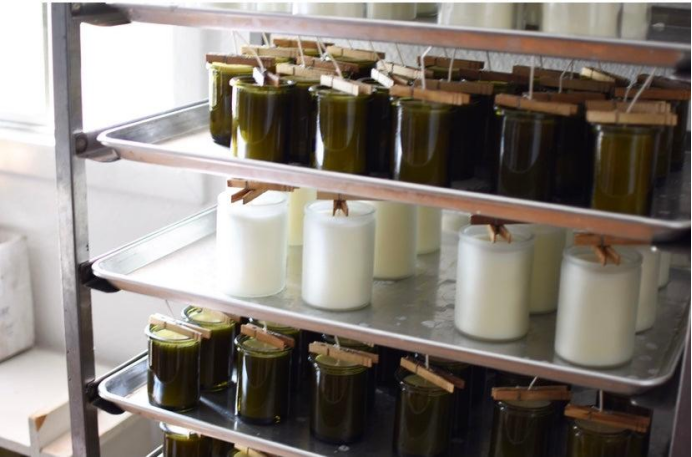
IV. Step 4: Filling and cooling also affect the product's appearance
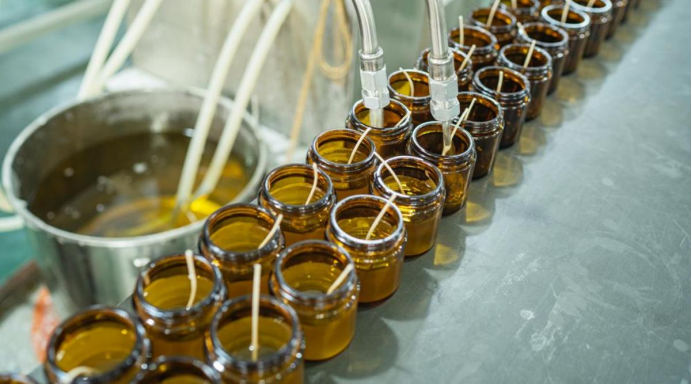
The production process for scented candles involves heating, mixing, filling, and cooling.
While these steps may seem simple, temperature and process control significantly impact the final result.
Improper control can lead to imperfections on the wax surface.
Examples include an uneven surface, air bubbles, localized textural irregularities, or poor adhesion between the wax and the container.
To the average consumer, these might appear to be merely "aesthetic issues."
However, for a brand, the product's appearance is a key factor by which consumers judge quality.
This is especially true for mid-to-high-end fragrance brands, as consumers often place these products in living rooms, bedrooms, bathrooms, or office spaces.
Therefore, a scented candle must not only burn well but also look appealing even when unlit.
V. Step 5: Attention must be paid to both "cold throw" and "hot throw"
This is a unique aspect of scented candles.
When consumers first receive the product, the scent they perceive is from the unlit candle—what is commonly known as "cold throw."
Once lit, the fragrance profile changes, and the consumer experiences the "hot throw."
If a product smells great unlit but the fragrance is weak when burning, consumers may still feel it lacks sufficient scent.
Conversely, if the fragrance is overpowering when burning, it can negatively affect the user experience.
Therefore, during product development, it is essential to evaluate the product's performance in both states. This is why you cannot judge a scented candle solely by using a fragrance test strip.
To understand what the final product is truly like, you must evaluate the product itself.
VI. Step 6: Burn testing is a crucial stage for scented candles.
Determining whether a candle meets quality standards ultimately comes down to how it performs after being lit.
Burn testing involves observing the product's behavior during actual use.
For example: Is the flame stable? Does the melt pool form correctly? Is the burn rate reasonable? Does the fragrance release meet expectations? Does the container perform properly during use?
These data points and observations help R&D personnel determine whether the formula and wick are well-matched.
If issues arise during testing, adjustments must be made.
Therefore, developing a scented candle is rarely a one-off task; it is an iterative process of testing, adjusting, and re-testing.
VII. Why is batch consistency important after mass production begins?
This is a critical issue for brands; creating a high-quality product during the R&D phase is not difficult.
The real challenge lies in maintaining that quality when producing 1,000, 5,000, or even more units.
A consumer might love the fragrance upon their first purchase.
If they buy it again months later and notice differences—such as changes in color, wax texture, fragrance profile, or burning performance—their trust in the brand could be compromised.
Consequently, factories must monitor not only the R&D phase but also raw materials, formulas, production processes, and the state of the finished product during mass production.
For a brand, a truly valuable supplier is one capable of consistently replicating the product's laboratory performance in mass production.
VIII. What should brands look for when choosing a scented candle factory?
If you are looking for a supplier, consider focusing on the following aspects:
Do they possess in-house R&D and fragrance formulation capabilities? It is not just about having off-the-shelf scents, but the ability to develop products tailored to the brand's positioning.
Do they conduct actual burn tests? It is not enough to simply show samples; they must be able to verify the final product's performance in use.
Can they adjust formulas and wicks? Different containers, wax materials, and fragrance profiles require specific matching and calibration.
Can they maintain consistency during mass production? Producing a great sample is just the beginning; long-term consistency across large batches is far more important.
Can they support the brand as it transitions from the testing phase to scaled-up production? This determines whether the supplier can truly grow alongside the brand. IX. Truly high-quality scented candles are the result of excellence across multiple stages
An outstanding scented candle cannot rely on excelling in just one area alone.
It requires a combination of: high-quality raw materials, suitable fragrance profiles, a well-balanced formula, a compatible wick, a stable manufacturing process, actual burn testing, and rigorous quality control.
A problem at any stage can compromise the final product.
So, when a consumer says, "This candle smells amazing,"
...there is actually a vast amount of unseen work behind that experience.
From the moment raw materials enter the factory to the completion of the final product, every step influences the consumer's experience—whether it lasts for a few hours, dozens of hours, or even longer.
For brands, choosing a top-tier, professional scented candle factory in Guangzhou, China, means focusing precisely on these details that often go unseen by the consumer.
How does BILA help brands develop fragrances for diverse products?
As a primary manufacturer with over 30 years of experience, we provide global brands with comprehensive, customized solutions and flexible, low-MOQ production support for new product incubation. Our product range spans scented candles, perfumes, liquid diffusers, smart diffusers, and more. We manage the entire process—from fragrance R&D, product design, and custom bottle/packaging creation to compliant manufacturing and final delivery.
Why global clients choose to partner with us (Our core strengths):
✨ Flexible MOQs: From Customization to Mass Production
We support small-batch orders, helping brands minimize market testing risks and inventory pressure, while also meeting mass production needs to drive market growth.
✨ End-to-End Customization Services
We offer one-stop services covering everything from fragrance R&D, custom packaging materials and visual design, to logistics and customs clearance that meet global compliance standards.
✨ Empowering Brand Growth with an International Perfumer Team
Our team of international perfumers helps brands capture cutting-edge fragrance trends, boost market competitiveness, and achieve sustainable growth.
✨ Over 30 Years of Industry Experience & Authoritative EU Certifications
Our products and services reach over 40 countries worldwide, complying with EU regulations and global industry standards such as IFRA, REACH, and CE. ✨ Artistic Fragrance & Eco-conscious Philosophy
We create collectible, heirloom-quality scented candles that offer multi-functional utility, championing the use of pure plant-based ingredients for a natural, healthy lifestyle.
Whether you are a brand owner, retailer, wholesaler, distributor, cross-border e-commerce seller, independent online merchant, corporate client, or trader—and whether you are seeking a reliable supply chain partner or looking to scale up production for existing projects—we stand ready as your steadfast supply chain backbone. Contact us today.
FAQ
1. Why do scented candles require burn testing?
Since candles are ultimately used by burning, the "cold throw" (scent when unlit) does not fully reflect the actual user experience. Burn testing helps evaluate performance aspects such as flame stability, wax pool formation, and fragrance diffusion.
2. Is a stronger scent always better?
No. Fragrance intensity must align with the product positioning, the size of the space, and the consumer experience; intensity that is either too strong or too weak can detract from the overall experience.
3. Why might a fragrance need adjustment when switching wax materials?
Different wax materials possess unique properties that affect how fragrance oils blend and diffuse. Consequently, applying the same scent to a different wax type usually requires product reformulation to ensure optimal performance.
4. How is consistent quality ensured during mass production?
Quality consistency is maintained through comprehensive control measures—spanning raw materials, formulations, and production processes to final product inspection—and by utilizing standardized production methods to minimize batch-to-batch variations.
Conclusion
A scented candle may appear simple, but crafting a truly excellent one requires meticulous control at every stage, from raw materials to burn performance.
BILA Fragrance Factory offers custom manufacturing services—covering everything from scent development to quality testing—ensuring every candle stands the test of excellence.