
When you walk into a hotel, you might notice the lighting, décor, music, and service in the lobby.
Yet, there is an experience that often goes unnoticed at first glance but leaves a lasting impression long after you leave—
Scent.
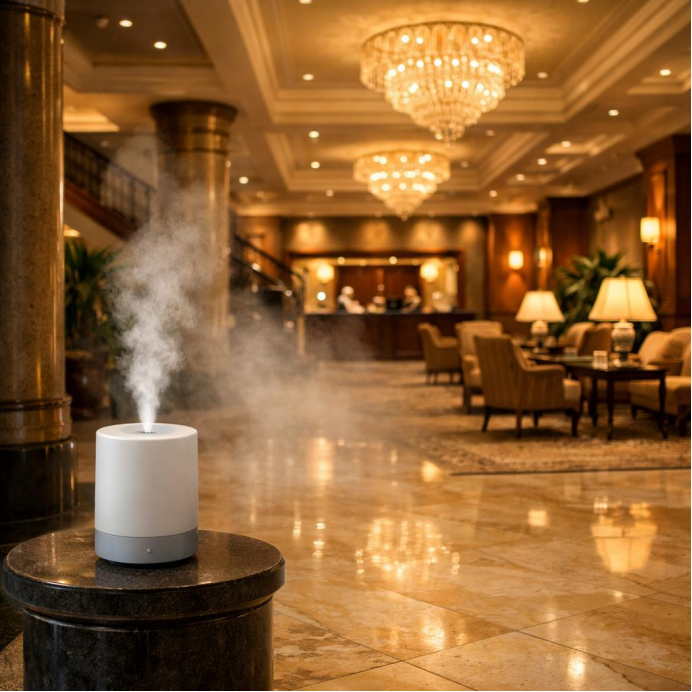
Hotels employ various forms of fragrance in lobbies, corridors, guest rooms, and even restrooms; meanwhile, commercial spaces, private clubs, restaurants, and brand stores are beginning to incorporate scent into their overall spatial design.
This is not merely about making a space "smell better."
For commercial spaces that increasingly value the customer experience, scent is becoming an integral part of the atmosphere and the brand experience.
I. Why Is Visual Design No Longer Enough?
In the past, commercial spaces relied primarily on visuals to establish their unique style.
Décor, lighting, furniture, logos, color schemes, and product displays combined to form the consumer's first impression of a space.
However, the visual styles of many hotels and commercial spaces are becoming increasingly similar.
High-end hotels adopt similar minimalist designs, boutiques use comparable lighting and materials, and commercial spaces are increasingly prioritizing a unified visual language.
Consequently, brands have begun seeking alternative ways to create a differentiated experience.
Scent is one such option.
It does not compete for the consumer's visual attention, yet it naturally engages the senses as soon as one enters the space.
When a brand combines visuals, sound, and touch with scent, the spatial experience becomes truly complete.
II. Why Do Hotels Place Such High Importance on Scent?
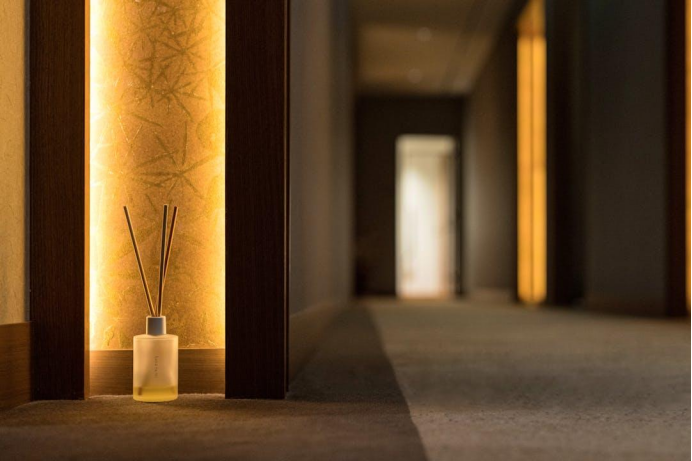
Hotels represent a quintessential "experience-based" form of consumption.
Consumers are purchasing more than just a room; they are buying into the entire journey—from entering the lobby and checking in to settling into their room and utilizing public areas.
Therefore, hotels must consider the cohesive experience across these different spaces.
For instance, the lobby might feature a highly distinctive signature scent, public areas could maintain a consistent brand fragrance, and guest rooms might utilize softer, more subtle scent products.
A lack of connection between these areas could result in a disjointed overall experience.
Thus, for hotels, scent design is not simply a matter of "placing a diffuser"; it requires careful consideration of:
Spatial dimensions, diffusion methods, fragrance intensity, timing, product placement, and the overall brand identity. III. Commercial Spaces Also Need Their Own "Scent Language"
Beyond hotels, an increasing number of commercial spaces are paying attention to scent.
For example:
Clothing stores want the ambient scent to align with their brand style;
Beauty salons and spas focus heavily on the overall environmental experience;
Restaurants and cafes must consider the relationship between the scent and the food and beverages served;
Car showrooms aim to enhance the brand experience through the atmosphere of the space;
Office spaces and private clubs may use different fragrance products for different zones.
These scenarios share a common trait:
Consumers do not visit these places specifically to purchase fragrance products.
However, the scent can become an integral part of the overall spatial experience.
Therefore, the fragrance needs of commercial spaces differ from a typical consumer buying a scented candle.
The focus shifts toward spatial compatibility and long-term usage.
IV. Scent Design in Commercial Spaces Places Higher Demands on Suppliers
Simply producing a pleasant-smelling perfume is vastly different from developing a scent strategy for a hotel or commercial space.
Commercial spaces often involve complex practical considerations.
For instance, varying floor areas require different scent diffusion intensities;
Different zones—such as lobbies, guest rooms, and corridors—have distinct functional requirements;
Different diffusion equipment necessitates specific adjustments to fragrance formulations;
Furthermore, commercial clients may require scent consistency across various product formats, such as candles, diffusers, and room sprays.
Consequently, a successful commercial fragrance project requires comprehensive planning—spanning scent development, scenario analysis, product selection, formulation adaptation, testing, and mass production.
This is why many hotels and commercial brands, when selecting suppliers, prioritize capabilities in R&D and implementation over mere product pricing.
V. From "Ambient Scent" to "Signature Brand Scent"
When a commercial brand consistently uses a distinctive scent over time, it has the opportunity to create a unique "olfactory memory."
For example, upon entering a space, a consumer might associate the environment with the brand based on the familiar scent alone, even before seeing the logo.
Of course, creating such a scent involves more than simply replicating an off-the-shelf fragrance.
A scent that truly embodies brand identity must be developed by integrating brand positioning, spatial style, target demographics, and actual usage scenarios.
This represents a key distinction between commercial fragrance projects and the development of standard consumer fragrance products. Brands are not merely seeking a "pleasant scent"; they are asking:
"What kind of scent truly represents this space?"
VI. Future commercial fragrance: More than just a product
As venues such as hotels, retail stores, clubs, and restaurants place increasing importance on the customer experience, commercial fragrance is shifting from the procurement of isolated products toward comprehensive, integrated solutions.
Brands may no longer require just a few cases of diffuser oil, but rather a complete product portfolio:
Space-wide diffusion systems to manage the overall environment;
Fragrance oils for continuous scenting;
Scented candles, sprays, and similar items for use in guest rooms, concierge areas, events, or as brand gifts.
If a brand wishes to extend the experience into the consumer's home, it can further develop perfumes, home fragrance products, or gift sets.
In this way, the core scent profile used in a commercial space can evolve from a "spatial experience" into a "consumer experience."
VII. Scent design ultimately serves the spatial experience
The fact that hotels and commercial spaces are prioritizing scent does not mean every space requires an intense fragrance.
Quite the opposite.
Effective scent design requires striking a balance between presence and comfort.
It should complement the space's visual aesthetics, functionality, and brand positioning, rather than standing as an isolated element.
For commercial brands, the question worth asking is not:
"Should we use fragrance?"
But rather:
"If a consumer remembers this space, what kind of scent do we want them to recall?"
Once this question is seriously considered, scent ceases to be merely a utility for the space and becomes an integral part of the brand experience design.
How does BILA help brands develop scents for diverse products?
With over 30 years of experience as a primary manufacturer, we provide global brands with comprehensive, customized solutions and flexible production support—including low minimum order quantities—for new product incubation. Our product range spans scented candles, perfumes, liquid fragrances, smart diffusers, and more. We manage the entire process, from scent R&D, product design, and custom bottle/packaging creation to compliant production and final delivery. Why global clients choose to partner with us (Our core strengths):
✨ Flexible MOQs: From Customization to Mass Production
We support small-batch orders to help brands minimize market testing risks and inventory pressure, while also meeting mass production needs to drive market growth.
✨ End-to-End Customization Services
We provide a one-stop solution covering everything from fragrance R&D, packaging customization, and visual design to customs clearance and shipping that meets global compliance standards.
✨ Empowering Brand Growth with an International Perfumer Team
Our team of international perfumers helps brands capture cutting-edge fragrance trends, enhance market competitiveness, and achieve sustainable growth.
✨ 30+ Years of Industry Experience & EU Certifications
Our products and services reach over 40 countries, complying with EU regulations and global industry standards such as IFRA, REACH, and CE.
✨ Artistic Fragrance & Eco-friendly Philosophy
We create collectible, heirloom-quality artistic fragrances that offer multi-functional utility, while championing natural, healthy, plant-based ingredients.
Whether you are a brand owner, retailer, wholesaler, distributor, cross-border e-commerce seller, independent online store operator, corporate client, or trader—and whether you are seeking a reliable supply chain partner or looking to scale up production for existing projects—we stand ready as your solid, dependable supply chain backbone. Contact us today.
FAQ
Q1: Why do hotels need a signature scent?
A signature scent serves as part of the spatial experience, creating a unified brand identity that complements the hotel's visual aesthetics and service standards.
Q2: What fragrance products are suitable for commercial spaces?
The choice depends on the space size, usage scenario, and diffusion method; options include smart diffusers, liquid diffusers, scented candles, and fragrance sprays.
Q3: Can a hotel's signature scent be adapted into perfumes or scented candles?
Yes. Brands can develop various products around a core fragrance profile, though formula adjustments and testing are required to suit specific product categories.
Q4: Where should one start when creating a signature scent for a commercial space?
Typically, the process begins by defining the brand positioning and the intended use of the space, followed by fragrance R&D, testing, and product development. Drawing on brand positioning and spatial context, BILA develops signature scents for hotel and commercial brands—extending into products such as diffusers, liquid fragrances, and scented candles—to ensure that scent becomes an integral part of the brand's spatial experience.
Text/Photos: BILA
Copyright and Right of Interpretation held by
BILA Biotechnology (Guangzhou) Co., Ltd.