
From scent formula to product experience: why does the same fragrance profile perform differently across perfumes, home fragrances, and candles?
A common question arises in the fragrance industry:
Why does the same scent profile evoke one feeling when made into a perfume, yet offer a completely different experience when transformed into a scented candle or a liquid diffuser?
For instance:
Consider a woody scent profile.
When used in a perfume, it might project a warm, mature, and elegant personal aura;
When used in a scented candle, it might create a softer, more enveloping atmosphere within a space;
When used in a liquid diffuser, the focus might shift toward consistent diffusion and environmental compatibility.
Many consumers assume that if the scent is the same, the product experience should be identical.
In reality, however, the final effect of a fragrance product is not determined solely by the scent profile itself; it is shaped by a combination of factors, including:
The product medium (carrier), formulation system, release mechanism, usage environment, and manufacturing process.
For brands, understanding a key concept during product development is essential:
While a single scent profile can serve as a unified olfactory asset for a brand, it cannot simply be replicated across every product category.
This is precisely why a professional fragrance supply chain requires not only manufacturing capabilities but also expertise in multi-category R&D and product adaptation.
I. The scent profile is merely the foundation; the product format determines the final experience.
When developing fragrance products, many brands operate under the assumption that:
Once a popular scent is found, it can be applied to all products.
In reality, fragrance products are akin to a single ingredient prepared using different cooking methods—each yields a distinct sensory experience.
The same applies to fragrance.
The performance of a specific scent profile must be fine-tuned to suit the characteristics of the product.
For example:
Perfumes require a focus on the interaction between the wearer and the scent;
Scented candles require a focus on diffusion performance during the burning process;
Liquid diffusers require a focus on consistent release within a space.
Therefore, fragrance R&D is not merely about replicating a scent, but about adapting that scent to suit different usage scenarios. II. Why do the experiences of perfumes, scented candles, and liquid diffusers differ?
1. Perfumes focus on how the scent evolves on the body
Perfumes are the fragrance products most intimately connected to the consumer.
They are influenced by factors such as skin temperature, individual body chemistry, the surrounding air, and the time of application.
Consequently, perfume development places greater emphasis on the layering of the scent.
A well-crafted perfume typically presents:
Top notes: The initial impression upon first contact.
Middle notes: The primary character that emerges as the scent unfolds.
Base notes: The lingering impression that remains over time.
Thus, the goal of a perfume is not merely intensity, but a complete, evolving olfactory journey.
2. Scented candles focus on spatial ambiance
The primary difference between scented candles and perfumes is that candles are designed to enhance a space.
Consumers purchase scented candles to elevate the room's atmosphere, create a relaxing environment, and add a sense of ritual to their lives.
Therefore, candle development requires consideration of factors such as wax type, burning temperature, fragrance release rate, and the reach of the scent within the space.
Simply replicating a perfume formula for a candle may not yield the desired result.
This is because the wax material itself affects how the fragrance is released.
Professional development involves adjusting the fragrance profile to suit the specific characteristics of the wax.
3. Liquid diffusers emphasize continuous, stable scent diffusion
Liquid diffusers are primarily used in homes, hotels, offices, and commercial spaces.
Compared to perfumes and candles, they prioritize duration, coverage area, and consistent release.
Key considerations include evaporation rates, the compatibility of the fragrance with the solvent, and suitability for the size of the space.
The performance of the same fragrance can vary significantly depending on whether the space is small or large.
III. Three key factors influencing the fragrance product experience
1. Differences in formulation systems
Different products require different development approaches.
For example:
Perfumes focus on performance on the body;
Scented candles focus on burning performance;
Liquid diffusers focus on evaporation performance.
Therefore, professional fragrance manufacturers must tailor their methods to the specific product type rather than simply applying a one-size-fits-all formula. 2. Differences in raw material combinations
Fragrance products are typically composed of various aromatic ingredients.
Different ingredients vary in terms of volatility, stability, and olfactory characteristics.
Perfumers must select and combine them based on the product's intended purpose.
For example:
To create a sense of sophistication, one must consider the layering of the scent;
To ensure longevity, one must focus on the performance of the base notes;
To set the mood of a space, one must consider the scent's diffusion and reach.
3. Differences in usage scenarios
Fragrance products ultimately serve the consumer's lifestyle.
Different settings call for different scent profiles.
For example:
Bedrooms: Require scents that are comforting and soft.
Living rooms: Require scents that can fill and define the space.
Office areas: Require scents that are fresh and clean.
Therefore, product development must take real-world usage scenarios into account.
IV. Why do brands need to create fragrance product lines?
For an increasing number of brands, a single product is no longer sufficient to meet market demand.
Consumers desire a comprehensive experience.
Consequently, many brands are developing product lines that include perfumes, scented candles, home diffusers, and fragrance gift sets.
This approach helps brands expand usage scenarios, enhance product value, and build brand recognition.
However, developing a product line does not mean every product must be identical.
The truly professional approach is to maintain a consistent core scent profile while optimizing performance based on the specific characteristics of each product.
This ensures that consumers perceive a unified brand identity across the entire range.
V. Scent is becoming a key brand asset
In the past, consumers primarily identified brands through:
Logos, packaging, and visual design.
Today, more brands are focusing on:
Olfactory identity, as scent possesses powerful memory-triggering qualities.
A unique brand scent helps consumers establish a mental link:
Smelling a specific scent → Associating it with the brand.
For example:
Hotels creating signature scents for their spaces;
Lifestyle brands launching distinctive fragrance collections;
Companies developing custom-made fragrance gifts.
Thus, scent has evolved from a mere product element into an integral part of brand equity.
VI. How should brands select a professional fragrance supply chain?
When developing fragrance products, brands need to look beyond simply whether a manufacturer exists. More importantly:
Do they understand the R&D logic behind different products?
Do they possess experience in manufacturing across multiple product categories?
Can they provide comprehensive customization services?
A top-tier professional fragrance factory in Guangzhou, China, should be capable of assisting brands with:
Fragrance development; product design; formula adjustment; custom packaging; quality control; and mass production.
Only in this way can a specific fragrance truly evolve into a market-competitive product line.
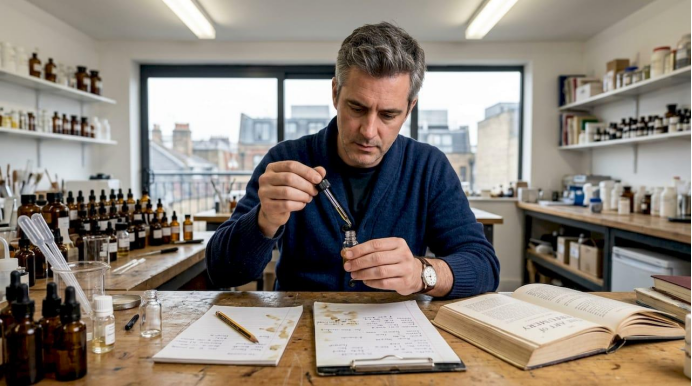
How does BILA help brands create a diverse range of fragrance products?
As a manufacturer with over 30 years of experience, we provide global brands with end-to-end customization solutions for new product incubation and flexible production support with low minimum order quantities (MOQs). Our product portfolio spans multiple categories, including scented candles, perfumes, liquid diffusers, and smart fragrance diffusers. We manage the entire process—from fragrance R&D, product design, and custom bottle/packaging creation to compliant manufacturing and delivery.
Why global clients choose to partner with us (Our core strengths):
✨ Flexible MOQs: From Customization to Mass Production
We support small-batch orders, helping brands minimize market testing risks and inventory pressure, while also meeting mass production needs to drive market growth.
✨ End-to-End Customization Services
We offer a one-stop service covering everything from fragrance R&D, custom packaging materials, and visual design to customs clearance and shipping that meets global compliance standards.
✨ Empowering Brand Growth with an International Perfumer Team
Our team of international perfumers helps brands capture cutting-edge fragrance trends, enhance market competitiveness, and achieve sustainable growth.
✨ Over 30 Years of Industry Experience & EU Certifications
Our products and services reach over 40 countries worldwide, complying with EU regulations and global industry standards such as IFRA, REACH, and CE.
✨ Artistic Fragrance & Eco-friendly Philosophy
We create collectible, heirloom-quality fragrance products that offer multi-functional utility, while championing natural, healthy, and plant-based ingredients. Whether you are a brand owner, retailer, wholesaler, distributor, cross-border e-commerce seller, independent online store operator, corporate client, or trader—and whether you are seeking a reliable supply chain partner or looking to scale up production capacity for existing projects—we stand ready as your steadfast and dependable supply chain backbone. Contact us today.
FAQ
Q1: Can the same fragrance profile be used across different fragrance products?
Yes, though formula adjustments are required to suit the specific characteristics of different products, such as perfumes, scented candles, or liquid diffusers.
Q2: Why does the same fragrance smell different in various products?
Factors such as the product medium, diffusion method, usage environment, and formulation system all influence the final scent profile.
Q3: Can a brand create its own exclusive fragrance collection?
Yes; through professional R&D, a unified brand olfactory identity can be established.
Q4: What capabilities should be prioritized when selecting a fragrance supplier?
Beyond manufacturing capacity, it is essential to consider R&D capabilities, the ability to develop diverse product categories, and customization services.
BILA Fragrance Customization Factory empowers brands to transform a single scent into a comprehensive brand fragrance experience through professional fragrance development and multi-category customization capabilities.
Text/Photos: BILA
Copyright and Right of Interpretation held by
BILA Biotechnology (Guangzhou) Co., Ltd.