
From the burning experience to fragrance performance—how is a high-quality scented candle crafted to ensure a consistent experience?
In recent years, scented candles have evolved from simple household items into products that allow consumers to express their lifestyles and aesthetic preferences.
When purchasing scented candles, consumers look beyond the simple question: "Does it smell good?"
They also consider: Is the experience pleasant once lit? Is the fragrance natural? Is the burn stable? Does the appearance complement the space's aesthetics?
For brands, developing a market-competitive scented candle involves more than just selecting a wax type and adding fragrance oil.
During the initial development phase, many brands focus heavily on:
Plant wax, soy wax, beeswax, and coconut wax.
In reality, however, the wax material is just one factor influencing a candle's performance.
The product experience is truly determined by an integrated system comprising the wax, fragrance, wick, formula ratios, container, and production process.
Therefore, creating an excellent scented candle requires a development approach that considers the overall formula.
I. Why focusing solely on wax material cannot determine a scented candle's quality?
In marketing, "natural plant wax" is often a key selling point for consumers.
Examples include soy wax, coconut wax, and blended plant waxes.
These materials certainly influence burning characteristics, texture, appearance, and fragrance throw.
However, the candle's final performance is not determined by the wax alone.
Even with high-quality wax, ignoring other factors can lead to issues such as poor fragrance throw, uneven burning, surface cracking, or an unsatisfactory melt pool.
Thus, brands must focus on balancing the overall formula when developing scented candles.
II. What are the core factors influencing scented candle performance?
1. Wax selection affects the foundation of the burn
Wax is a crucial component of a scented candle.
Different waxes possess distinct characteristics.
For instance, plant waxes often emphasize natural origins and eco-friendly attributes. Blended waxes combine the advantages of different materials to enhance stability.
Beeswax offers a unique texture and natural properties.
Brands must select the appropriate wax formulation based on product positioning, price range, and consumer needs.
However, a more expensive wax is not necessarily better; the wax must align with the overall formula.
2. Fragrance ratio affects scent performance
The fragrance experience is a core value of scented candles, but a higher fragrance ratio is not always better.
Too low: May result in insufficient scent.
Too high: May compromise burning performance.
Professional R&D involves adjusting the ratio based on wax characteristics, fragrance structure, and intended use.
This ensures consumers enjoy a natural, comfortable, and enduring fragrance experience.
3. Wick choice affects burning performance
Many consumers overlook the importance of the wick.
In reality, the wick directly influences flame size, burn rate, melt pool formation, and safety.
Different candle vessel sizes require wicks of specific specifications.
Mismatched pairings can lead to incomplete combustion, black smoke, or uneven melting.
Therefore, professional scented candle development requires testing to ensure the right match.
III. Why do different brands achieve different results using the same wax?
Many brands on the market use similar wax materials.
Yet, the final product experience varies.
The reasons lie in differences in formulation systems, production processes, and testing standards.
For example, even when both use plant-based wax:
One brand might prioritize fragrance intensity.
Another might focus on burn time, scent throw (diffusion), and visual aesthetics.
Thus, truly excellent scented candles are developed with specific brand positioning in mind.
IV. What tests should brands conduct when developing scented candles?
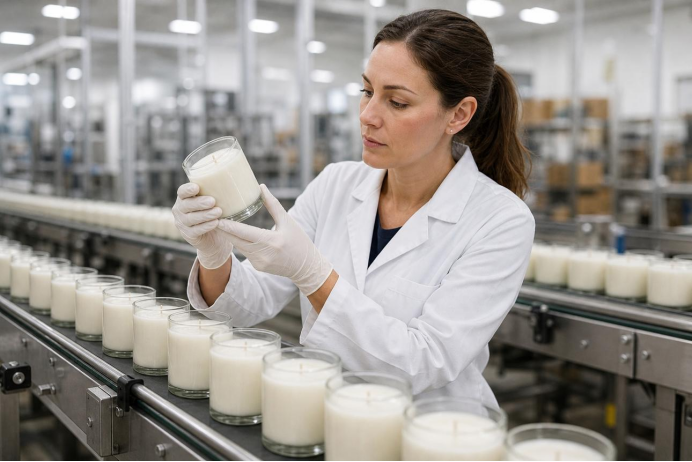
To ensure a consistent product experience, professional supply chains typically conduct:
1. Burn tests
Focus areas: Burn time, flame behavior, melt pool characteristics, and safety.
2. Fragrance tests
Cold throw (scent before lighting), hot throw (scent diffusion while burning), and fragrance longevity.
3. Stability tests
Focus areas: Performance across different ambient temperatures, storage conditions, and transportation. This is especially true for export-oriented brands, as products must adapt to the market environments of different countries.
V. High-quality scented candles are evolving from mere products into objects of artistic value.
Today, consumers purchase scented candles for more than just their fragrance.
Increasing attention is being paid to product design, material aesthetics, spatial integration, and brand philosophy.
Consequently, premium scented candles are becoming home art pieces, lifestyle products, and items valued for their emotional appeal.
Particularly in the gift, high-end home décor, and boutique markets, consumers are willing to pay a premium for unique designs, craftsmanship, and compelling brand stories. This drives brands to place greater emphasis on:
Product R&D, packaging design, and supply chain capabilities.
VI. How can a professional scented candle supply chain help brands boost competitiveness?
When selecting a supplier, brands should look beyond just:
Price, MOQ (Minimum Order Quantity), and production speed.
They should also focus on:
Understanding of product R&D;
Testing capabilities;
Ability to provide customized solutions.
A top-tier professional scented candle factory in Guangzhou, China, must assist brands with:
Wax selection, formula development, fragrance adjustment, vessel design, and mass production.
This ensures consistent quality throughout the entire process, from the initial sample to final market sales.
How does BILA help brands create high-quality scented candle products?
With over 30 years of experience as an original manufacturer, we provide global brands with comprehensive, turnkey customization solutions and flexible, low-MOQ production support. Our product portfolio spans scented candles, perfumes, liquid diffusers, smart diffusers, and more. We manage the entire process—from fragrance R&D, product design, and custom packaging to compliant production and delivery.
Why global clients choose to partner with us (Our core strengths):
✨ Flexible MOQs: From Customization to Mass Production
We support small-batch orders, helping brands minimize market testing risks and inventory pressure, while also meeting large-scale production needs to drive market growth.
✨ End-to-End Customization Services
We offer a one-stop service covering everything from fragrance R&D, packaging customization, and visual design to customs clearance and shipping that meets global compliance standards. ✨ Empowering Brand Growth with an International Team of Perfumers
Our team of international perfumers helps brands precisely capture cutting-edge fragrance trends, enhance market competitiveness, and achieve sustainable growth.
✨ Over 30 Years of Industry Experience & Authoritative EU Certifications
Our products and services reach more than 40 countries worldwide, complying with EU regulations and global industry standards such as IFRA, REACH, and CE.
✨ Artistic Fragrance & Eco-friendly Philosophy
We create collectible, heirloom-quality artistic fragrance products that offer multi-functional utility, while championing natural, healthy, and plant-based ingredients.
Whether you are a brand owner, retailer, wholesaler, distributor, cross-border e-commerce seller, independent online store operator, corporate client, or trader—and whether you are seeking a reliable supply chain partner or looking to scale up production for existing projects—we stand ready as your steadfast and dependable supply chain backbone. Contact us today.
FAQ
Q1: Does the quality of a scented candle depend primarily on the wax material?
No, the wax is merely the foundation; the overall formula, fragrance oil, wick, and production process all influence the final experience.
Q2: Is plant-based wax necessarily better than other types of wax?
Different waxes have distinct characteristics; the right choice depends on the product's positioning.
Q3: Can brands create custom-made scented candles?
Yes, customization is available across various aspects, including fragrance, wax material, vessel, and packaging.
Q4: Does BILA support small-batch scented candle customization?
Yes, BILA offers flexible MOQ (Minimum Order Quantity) options to help brands minimize the risks associated with new product development.
BILA Fragrance Factory empowers brands to create market-competitive fragrance products by leveraging professional R&D capabilities to blend natural materials, unique scents, and artistic design.
Text/Photos: BILA
Copyright and Right of Interpretation held by
BILA Biotechnology (Guangzhou) Co., Ltd.